Activity 3 - Foundations of Google Analytics 4 + Setup
1. What is Google Analytics 4 ?
Before you start collecting, configuring, or analyzing data, you must understand what GA4 is, why it exists, and how it thinks.
This activity introduces the conceptual foundations of Google Analytics 4, explaining:
-
why GA4 replaced Universal Analytics,
-
how GA4 measures user behavior,
-
and how it supports modern, privacy-first marketing.
👉 Think of this activity as learning the language of GA4 before you speak it.
Complete all steps in the order below.
This is a conceptual module, but it directly prepares you for hands-on configuration in the next chapters.
Step 1: Read – What Is Google Analytics 4? (Required)
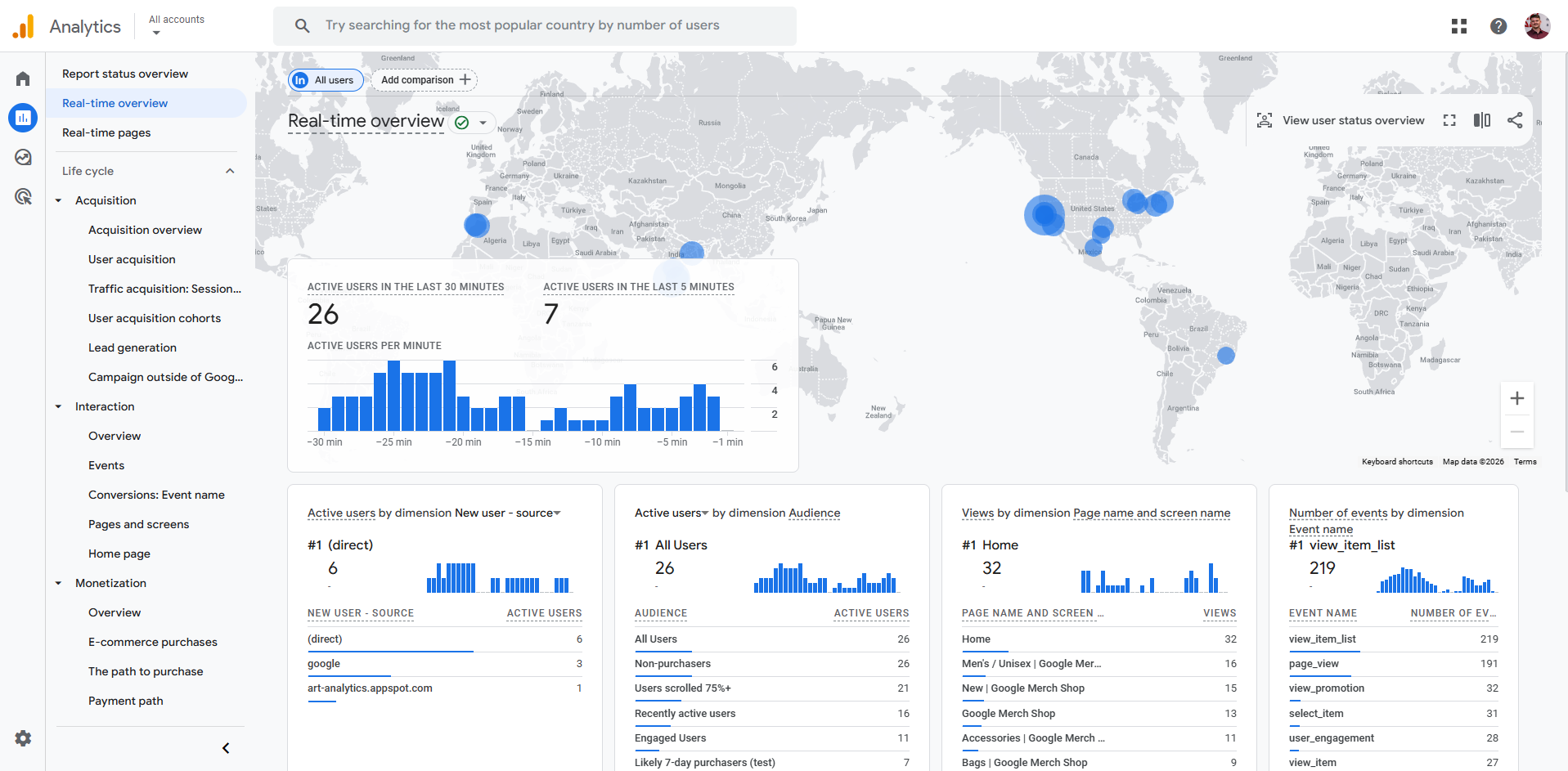
Google Analytics 4 (GA4) is the latest generation of Google's web analytics platform. In terms of modernization, Google Analytics 4 has undergone various modifications. Today, it is a tool for modern analytics used by many marketing agencies as well as individuals. Through GA4, we can create comprehensive and extensive analyses, measurements, and reports that serve to optimize various marketing activities of companies. Based on the data, we can track the customer lifecycle, adapt channels, content, and communication in each phase, and thus not only retain customers but also attract new ones. The platform has undergone many changes and modifications, especially since its previous version called "Universal Analytics." Today, its features meet the changing needs of the market and marketers, as well as market regulations, personal data protection, and the like. Compared to the previous UA model, GA4 is more event-based, more detailed, and more flexible in terms of user tracking. It allows marketers to set their own parameters and events, enabling them to adapt to clients and capture all important data. Automatically collected events such as first visit, demographics, and session start remain even with personalized settings. The main advantage is that no manual configuration or intervention in the website code is required. This makes it suitable even for those with less programming skills, while still allowing marketing agencies to identify weaknesses and remedy them. (Support.google.com, 2025)
Step 2: Listen – “The Invisible Conversation Behind Every Click”
🎧 Listen to the audio recording
Audio: The Invisible conversation behind every click
Instructions for students:
Answer the following questions based only on the audio recording.
Do not use the textbook, slides, or external sources.
- According to the audio, why is a single click never “just a click” in modern digital analytics?
- Why is understanding context more important than counting individual actions?
- What role does data play in revealing patterns that are not visible to marketers at first glance.
- Why does the audio suggest that intuition alone is no longer sufficient for marketing decisions?
- How does the audio justify the shift from pageviews to interaction-based measurement?
- What types of user interactions does the audio suggest are often overlooked but highly valuable?
-
Based on the audio, what is the main risk of collecting data without understanding its meaning?
Step 3: Understand GA4’s Core Objectives
The primary goal of GA4 is to provide a unified view of the customer journey.
-
Predictive Insights: Using AI to forecast user behavior (e.g., churn probability or potential revenue).
-
Privacy-First Tracking: Adapting to a world with fewer cookies and stricter regulations (GDPR/CCPA).
-
Holistic Measurement: Merging data from mobile apps and websites so you can see if a user browses on their phone and buys on their laptop.
Feature ✅ Advantages ❌ Disadvantages Data Model Event-based: Extremely flexible; tracks every interaction (click, scroll, file download) as a unique event. Learning Curve: It’s a total shift from the old session-based model, making it confusing for long-time users. Privacy Cookieless & Compliant: Built-in IP anonymization and better consent management tools. Data Thresholding: To protect privacy, Google may "hide" data in reports if user counts are too low. Integrations Free BigQuery Export: Previously a paid feature, anyone can now export raw data for advanced analysis. Interface: Many find the standard reports "empty" compared to UA; you often have to build your own. AI/ML Predictive Metrics: Can predict which users are likely to purchase or stop visiting. Data Delays: Standard reports can take 24–48 hours to fully process and display accurate data. Retention Cross-Device: Excellent at "stitching" together a single user across different devices. Short Storage: By default, exploration data is only kept for 2 months (must be manually changed to 14).
To successfully complete this activity, you must:
✔ Read the GA4 introduction text
✔ Listen to the full audio recording
✔ Understand GA4’s purpose, logic, and positioning
✔ Be able to explain (in your own words):
-
Why GA4 is event-based
-
Why privacy is central to its design
⚠️ No submission is required yet — this knowledge will be tested and applied later.